




Developer SEEP seems to operate in an alternate universe where the NES was never discontinued. With games like Ninja 1987, Airborne Justice, 1989 After the War, and, now, 1964 Operation Velvet Twins, the indie studio channels a simpler, purer period in the video game timeline, where players had only two buttons at their disposal and the biggest obstacle wasn’t a big bad boss battle but having to go to bed before finishing the game.
Like many NES games, 1964 Operation Velvet Twins is light on story. You assume the role of Agent Mike Rogers, an operative of the World Criminal Police Organization, in September 1964. His mission: to track down and neutralize two Eastern European terrorists known as the Velvet Twins. The Twins, who are sisters, have absconded with a Soviet nuclear submarine, planning to hold the United States to ransom.
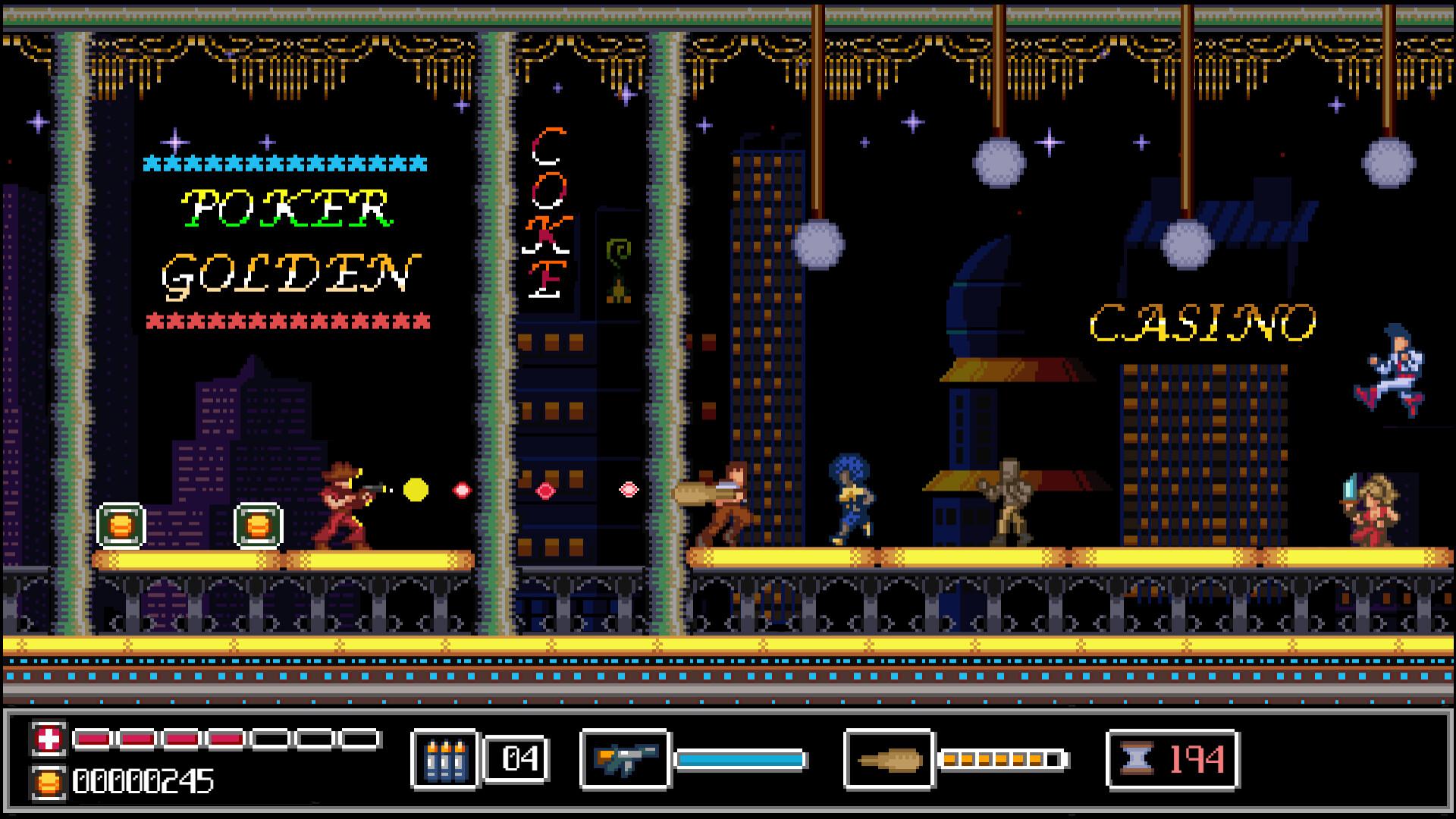
There’s nothing wrong with this premise, particularly in the context of NES-era game design. However, the specific story beats don’t make a whole lot of sense. Instead of taking the fight directly to the Velvet Twins, Rogers engages with a bunch of low-rent gangs operating on the periphery of the larger scheme. He starts in Las Vegas, before heading to New York Airport to interrogate a criminal posing as a flight attendant, before flying across the country to San Francisco. At one point he fights a tribal chief in an old western village, which apparently is operating as a front for black-market submarine gear. The internal logic of the game is all over the place.
The upside is that players will fight their way through many different backdrops. 1964 Operation Velvet Twins includes seven stages, which cover a factory, a casino, an airport, a jungle, and other settings. The change in scenery is nice because the level designs don’t evolve that dramatically. You’ll move left to right (or right to left) through mostly flat areas, attacking the rank-and-file enemies in your path. To be fair, later stages do experiment more with platforming trials, which turn out to be the best part of the game, not because they’re especially challenging or creative, but because the alternative — combat — is so clunky.
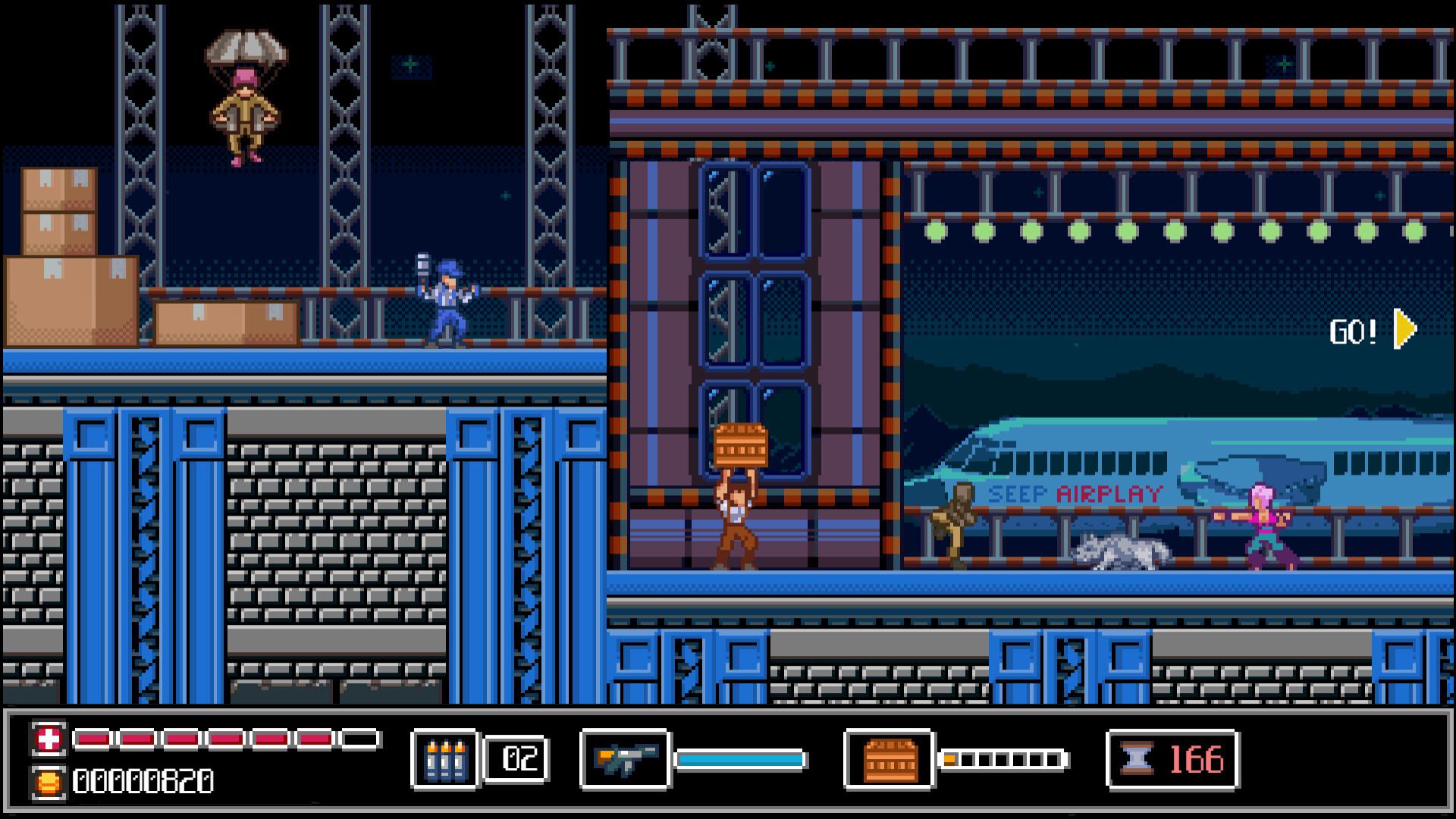
If you looked quickly at the screenshots for 1964 Operation Velvet Twins, you might think it was a run-and-gun game in the spirit of Rolling Thunder or Contra. That’s not the case, though. It has more in common, mechanically, with Renegade or Double Dragon. Rogers has a sidearm, but it has limited ammo. He also has a submachine gun, but it’s ideal only for emergencies, since it recharges slowly according to a timer. The best way to eliminate enemies is to punch them. Unfortunately, this isn’t very fun. Unlike games like Double Dragon, where there’s something of a dance to combat, the fighting in 1964 Operation Velvet Twins is stiff, predictable, and repetitive.
Here’s how the typical exchange goes down: you watch the enemy from afar until they’ve finished their attack animation, then you run up to them (Rogers has a very short reach, even if some hitbox abnormalities give him some wiggle room) and punch them four to eight times until they perish. The first punch stunlocks them, so all you need to do is mash the Y button from there. There’s nothing exciting or improvisational about it. It’s boring, it’s tedious, it’s the very definition of rote. You can pick up crates, bats, and pipes, which adds a little spice to the action, but not enough to overcome the feeling of monotony.
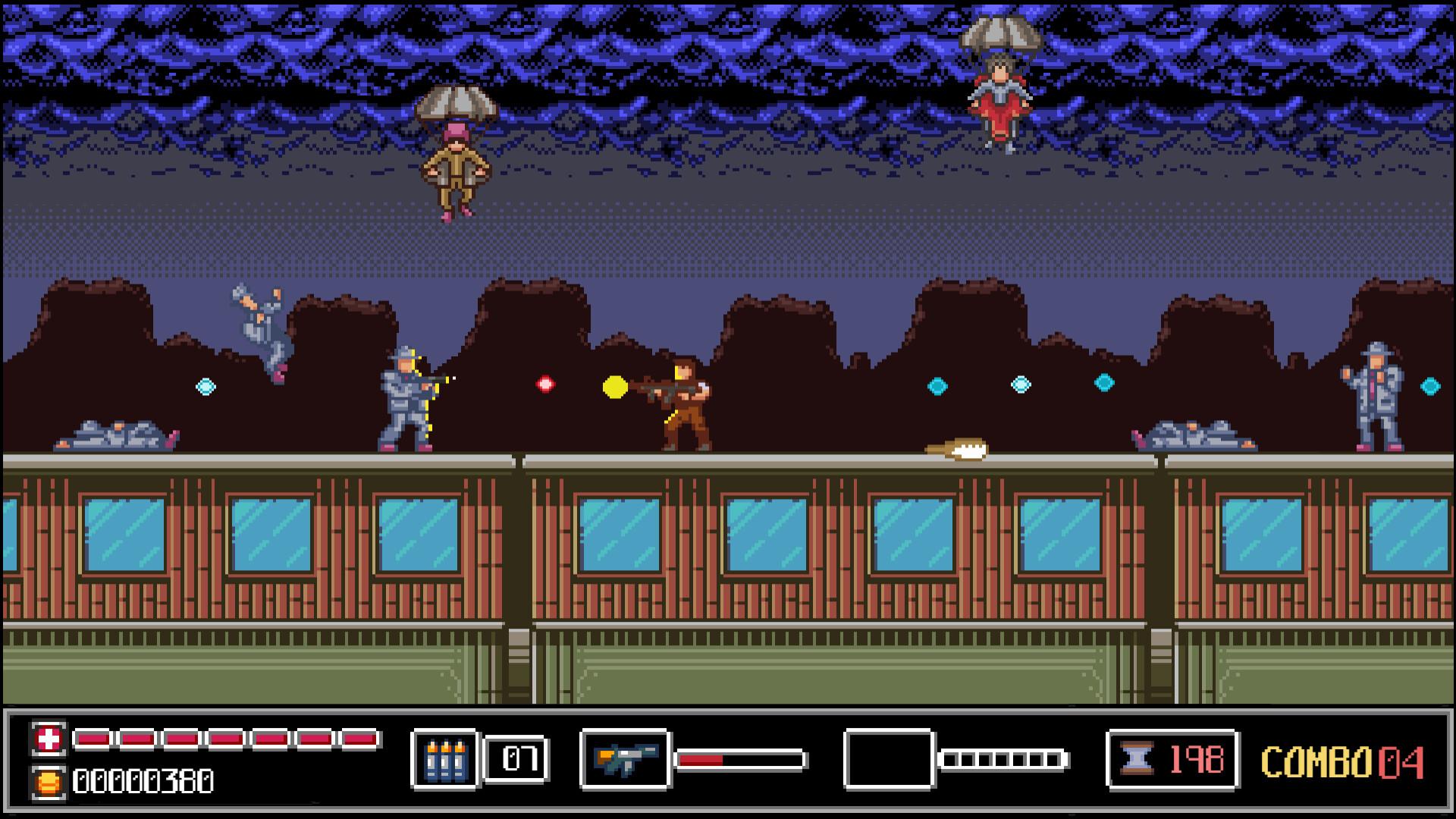
Because combat is so predictable and exploitable, the game is fairly easy. Only if you charge into the fray without a plan will you die prematurely. The exception to this rule is boss fights, not because they’re tough per se, but because it might take a death or two to figure out the rules. In general, the boss battles in 1964 Operation Velvet Twins are uneventful and dull, which seems to be an ongoing issue with SEEP games. It’s a problem in Ninja 1987 and Airborne Justice, and it’s a problem here. The first boss is a clown on stilts, who stands still and fires slow-moving projectiles, now and then taking a leisurely leap into the air. Once you understand the pattern, it’s just a matter of whittling down his pool of HP. This is the case for the majority of villains. One particularly monotonous fight tasks you with fetching and throwing explosive barrels at a stationary enemy who’s operating (easily avoidable) crushing machinery.
At least the game doesn’t overstay its welcome. With seven stages, each roughly 12 minutes long, 1964 Operation Velvet Twins lasts only about 90 minutes. Sadly, there aren’t any ancillary modes, remixed stages, or bonus features after the credits roll. Really, the only reason to revisit the game is to increase your high score. Interestingly, you can trade accumulated points within stages to a shady dealer to gain health, ammo, or extra time, thus reducing your score but enhancing your chances at survival, which is a neat risk-versus-reward mechanic.
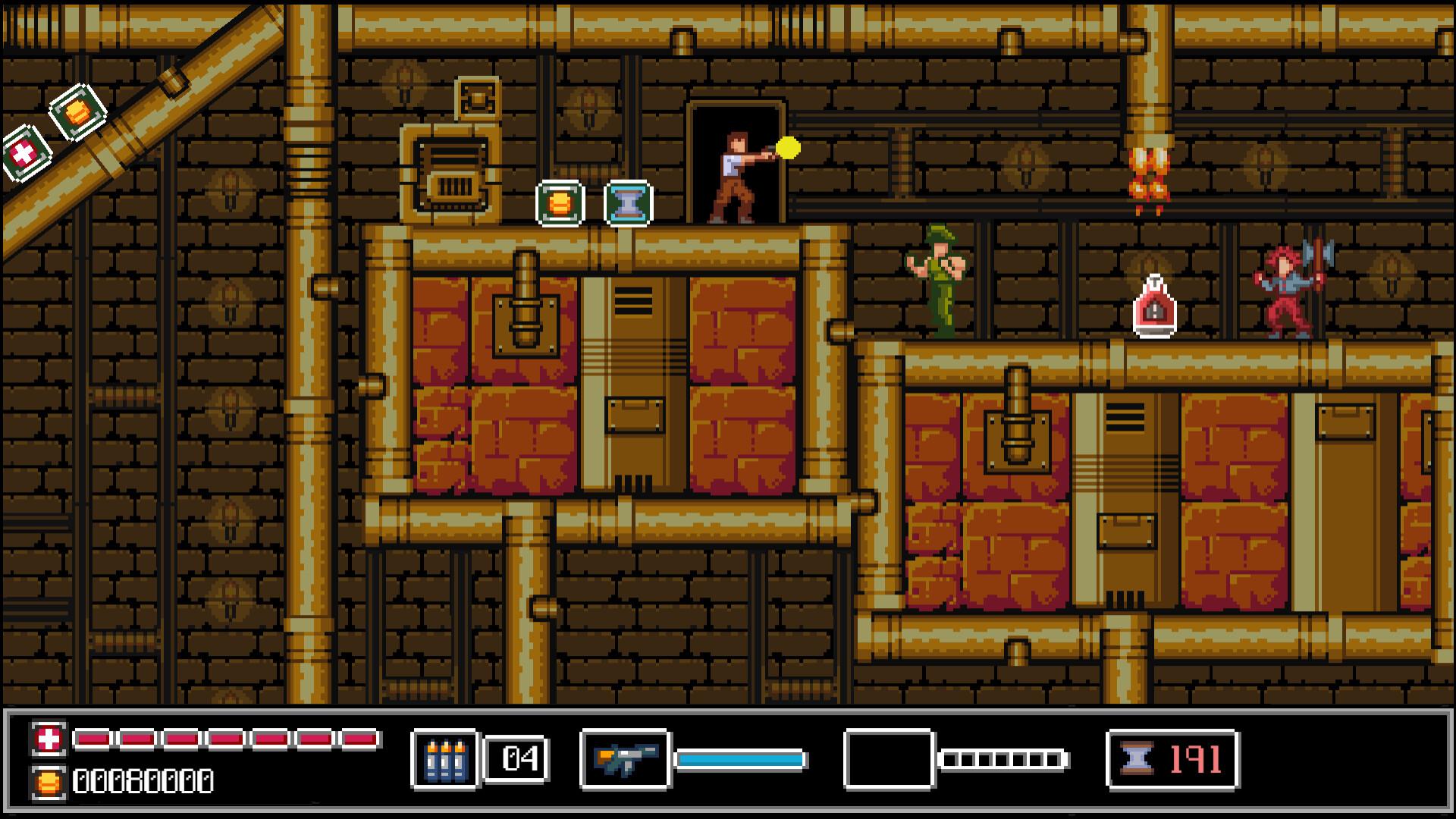
In terms of visuals, the game nails the 8-bit aesthetic, even as it lurches between dissimilar backgrounds and traffics in some incongruous elements (a cowboy with a six-shooter in an underground facility will always seem odd). Still, thanks to its characters, models, and effects, it looks like a long-lost NES game, which is exactly what you’d want. The static storyboard images that pop up between stages, however, are less successful. They’re not AI images, but they certainly look the part. The image of the Soviet submarine, in particular, is uncanny. It looks like something Tom Clancy dreamed up while reading lots of Jules Verne. According to a disclosure on Steam, SEEP used a few AI-rendered images as “internal references for proportions and framing”, but the final versions were crafted by hand.
As for the chiptune music, it’s appropriate for the era and sets the proper mood, but it fades from memory almost immediately upon turning off the console. The lone exception is the stage one track, with its funky base and bouncy melody.
With 1964 Operation Velvet Twins, SEEP has once again transported its players back to the NES era. Regrettably, due to its confused storytelling, clunky combat, and dull boss battles, it has more in common with one of those substandard games you’d regret renting from Blockbuster, rather than a classic you’d keep in regular rotation.
Full Article – https://www.vgchartz.com/article/469181/1964-operation-velvet-twins-ns/


