


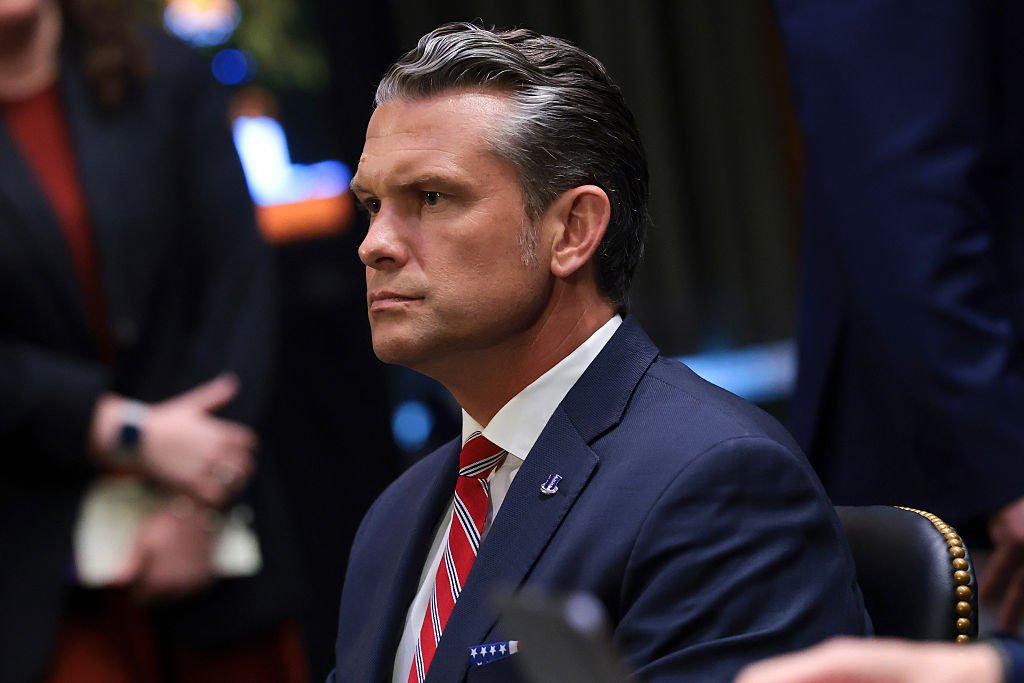
Defense Secretary Pete Hegseth announced on Wednesday that he had directed the U.S. military to cut 20% of the number of general roles.
The new reduction, which Hegseth revealed during an address at the Marine Corps Base Quantico in Virginia on Wednesday afternoon, doubles the already 10% cuts to general and flag officer positions that Hegseth instructed the military to make last year.
According to Fox News, which previously reported Hegseth’s intention to announce the cuts, military services are being ordered to finish making the reductions by Jan. 1, 2027. The network reported that some of the affected roles are expected to be downgraded, rather than cut entirely.
During his speech on Wednesday, Hegseth did not specify a timeline for the cuts, but said that “the number crunchers say we’ve fired 10% of the generals and admirals across the force, and that number sounds about right.”
“And I know—because I directed it—that we’ve also reduced the overall number of general officer slots by an additional 10%,” Hegseth said. “So yes, 20% reduction across the board.”
“Now, the media calls that a purge,” he continued. “I call it accountability, and long overdue, and frankly, the bare minimum. As usual, what the media levels as an accusation, I wear as an accomplishment. You see, you can’t change a culture with the same people who enabled it.”
Peter Feaver, a professor of political science at Duke University and a specialist in civil-military relations, says that many experts agree “that there probably could be a trimming of the general and flag officer ranks, that they had grown perhaps unnecessarily large in recent years, and that some rebalancing would be prudent if it was done carefully and managed carefully.”
“In the abstract, could the U.S. military absorb a 20% cut in general flag officer ranks if properly managed? I’d say yes, and I think most experts would say yes,” Feaver says.
He notes, though, that the 20% reduction also comes after additional cuts to the military’s top ranks, and on a relatively fast timeline.
“The burden will be on Secretary Hegseth and his team to demonstrate that they are making these cuts wisely and consolidating wisely and not recklessly,” Feaver says. “The faster they do it, and the less explanation that they give, and the more that really good officers are cut, the more doubt there will be.”
Upheaval in military leadership
During his speech, Hegseth referenced an address he gave in Quantico, Virginia last year, in which he outlined his vision for the Department of Defense. Last year’s speech, he said on Wednesday, “reestablished a singular mission for this department: warfighting. Preparing to fight and preparing to win. Unrelenting, unapologetic, and uncompromising in that single pursuit.”
“Now, I think the generals heard the message,” he continued. “Those who responded positively, which is most of them, are leading newly focused and newly empowered and disciplined formations. Those generals who did not, who clung to the ‘woke’ department or seemed to think civilian control of the military is simply a suggestion—well, they no longer work here.”
Hegseth’s speech comes at a time of turmoil within the military’s leadership: At least 20 military and civilian leaders have been pushed out or resigned since Hegseth was sworn in as Defense Secretary. In 2025, Hegseth told the active duty military to cut 20% of its four-star general officers and the National Guard to cut 20% of its top officials. It is not known if all of those reductions have been completed.
Hegseth said in a memo at the time that the reduction plan would eliminate “redundant force structure to optimize and streamline leadership” and that the goal was to prevent “unnecessary bureaucratic layers” within the military, The Associated Press reported.
“This is not a slash-and-burn exercise meant to punish high-ranking officers,” Hegseth said in May 2025. “This has been a deliberative process, working with the Joint Chiefs of Staff with one goal: maximizing strategic readiness and operational effectiveness by making prudent reductions in the general and flag officer ranks.”
Hegseth has faced a wave of backlash from Democrats and some Republicans over his management of the Department of Defense, in addition to his handling of other issues, such as the war in Iran. Republican Rep. Thomas Massie, who has clashed with the Trump Administration on multiple occasions since President Donald Trump returned to the Oval Office, introduced articles of impeachment against Hegseth earlier this month, including allegations regarding the Iran war.
Before that, Republican Sen. Thom Tillis of North Carolina publicly criticized Hegseth’s management of the agency, after Dan Driscoll resigned as Army Secretary amid reports of tension between him and Hegseth.
“I have never witnessed more inept management of the brave men and women who serve our country,” Tillis said in a social media post. “I urge the President to find a new leader at the Pentagon who will retain and empower our military talent rather than diminish it.”
Hegseth announces future plans
The Defense Secretary also unveiled a slew of new initiatives on Wednesday, including something called “Project Meridian,” which he said would be “an effort led by America’s best minds to study the future of warfare,” including “discovering, developing, and fielding the weapons and systems that our children and our grandchildren will need in their lifetimes … on any future battlefield, from under the Earth to beyond the Moon.” Hegseth said that Elon Musk, who previously served as one of President Donald Trump’s top advisers before their very public feud last year, along with former Republican House Speaker Newt Gingrich and Anduril co-founder Palmer Luckey, will co-lead the initiative.
Hegseth also announced that the Department of Defense plans to build “the next great American base.” He lamented that a new military base hadn’t been constructed within the U.S. in decades, and called on governors to “bring us their best sales pitch.”
“If your state wants the honor of hosting 15 to 25,000 of America’s great troops, show us why and how you’re going to do it,” he said.
A shift in military culture
During his speech, Hegseth applauded his efforts to eliminate what he called “woke” culture within the American military, such as rolling back diversity, equity, and inclusion initiatives.
“The only focus, as you know, in your formations should be training, readiness, accountability, discipline, and lethality. And when you pursue those things, you don’t have to walk on eggshells,” Hegseth said. “The complainers, the ideologues, and the poor performers are no longer in the driver’s seat. No more silly PowerPoint trainings or drag queen shows. No more diversity quotas. No more gender pronouns. No more identity months. Only the warrior ethos.”
“We are no longer the ‘woke’ department or the weak department,” he said. He went on to use derogatory terms to refer to people who are overweight and people who are transgender.
“No wimps, no radicals,” he said. “Just warriors. Just tough, ready, committed troops.”


