 Laura Bicker
China correspondent
 VCG via Getty Images
Tibet, which China annexed in the 1950s, is one of the most strictly controlled regions in the country.
It has long demanded greater autonomy and is heavily monitored because Beijing fears any signs of instability such as protests.
That is why orders have come personally from the top leader Xi Jinping, and Premier Li Qiang visited the site on Thursday. It is rare for him to make a visit so soon after a major disaster.
To get into Tibet requires a special visa and it is difficult, if not impossible, for foreign media to gain entry. Trying to contact people there is just as hard.
This makes it very difficult for us to know what is happening, and we are relying heavily on reports from Chinese state media.
Pilgrims making their way from Nepal through Tibet to the sacred mountain of Mount Kailash need four separate permits, which includes special permission from the Chinese military.
The number of people killed in Nepal has risen to 579, according to the latest release by Nepal’s National Disaster Risk Reduction and Management Authority (NDRRMA).
Officials say that around 4,000 people have been rescued.
We can now bring you more information from Nepal’s National Disaster Risk Reduction and Management Authority.
In its latest update, it says the number of people missing in Nepal has risen to 1,924, with 15,000 security personnel deployed in search and rescue operations.
That figure includes 517 foreign nationals, it says.
A little while ago we brought you an update from the Nepalese police, which said 575 foreign nationals were missing. The two authorities are separate, and the data from Nepal’s National Disaster Risk Reduction and Management Authority is dated two hours after the data released by the police.
The number of foreign nationals missing in Nepal has risen to 575, the Nepalese police have said.
That’s an increase from their last update around six hours ago, when they said around 537 foreign nationals were missing.
There are missing foreign nationals from 36 countries, it says, including 183 Indian nationals, 65 US nationals, and 62 Ukrainian nationals.
It says there are 33 British nationals missing.
There are 149 Nepalese tourists to the areamissing, it says.
Update 15:50: This post has been updated to clarify that 149 Nepalese tourists are missing. According to the latest government update 1,407 Nepalese people are unaccounted for.
By Charlotte Green and Benedict Garman
BBC Verify has authenticated two videos which show the moment of a glacier collapse in the Himalayas which triggered the deadly Nepal-Tibet floods.
The videos, filmed by a drone and posted to the Chinese social media platform Xiaohongshu, capture the landslide near the Langtang Lirung peak, more than 7,200m (23,600ft) above sea level.
Plumes of dust can be seen rising into the air near the snow-covered mountains.
The location of the clips match the direction of the floodwater which surged down the Trishuli river, devastating villages and communities along its way.
 Mark Poynting
Climate and science reporter
As we’ve been reporting, a barrier lake has formed in the region, where water has been collecting behind a natural dam of loose rock and mud.
One possibility is the water could slowly spill over the crest of the dam or seep through the rocks, which would allow the lake to gradually drain away.
But the fear is that could also destabilise the dam, potentially causing it to suddenly break apart.
This could allow much of the lake water to be released at once.
“Unlike an engineered dam, this barrier has no spillway and no solid core,” says Dr Fatima Pillosu of the University of Reading.
“So, dams of this kind often fail, many within days or weeks of forming,” she adds.
Scientists will be closely monitoring the lake’s water levels and any changes to the structure of the dam.
But they say it’s not possible to predict exactly when – or even whether – a sudden collapse will happen.
We’ve got more detail on the barrier lake in a separate story here.
China has warned there is a “high risk” that a lake which formed after the landslide could breach its banks.
A type of barrier lake, a body of water formed when debris dams a river, concerns over its levels saw rescue efforts temporarily suspended today, but they have since resumed.
In the video below, our China correspondent Laura Bicker talks you through why officials are so concerned about it.
In Nepal, rescue efforts are continuing following deadly flash floods.
Helicopters have been drafted in to rescue those stranded.
Away from the worst-hit areas, family members are lining up to speak to officials about their missing relatives.
 EPA
EPA
 EPA
EPA
 Getty Images
Adam Mandeville
Reporting from Belfast

Sabin Pandey lives in Northern Ireland and helps to runa tour company in Nepal.
Sabin’s cousin, who is a tour guide in the region, has been missing since the disaster, along with 46 other people in the tour group.
“It’s a very difficult time,” he tells BBC Radio Ulster’s Good Morning Ulster.
At first, Sabin thought the lack of signal was stopping the group from making contact. But, when Sabin’s brother took a helicopter over the hotel the group had been staying in, he says there was “no trace” of the building.
“My heart sank. The whole hotel is completely rubble.”
Now, Sabin believes there are “very slim chances that we could get any survivors”.
Shreejana Shrestha
BBC Nepali, reporting from Nuwakot

BBC Nepali’s Shreejana Shrestha travelled to Nuwakot, one of the main affected districts in central Nepal, to visit an army camp that had been turned into a search and rescue centre. This is what she saw.
I entered the camp to an absolutely heartbreaking scene.
Hundreds of people were queuing outside, desperately trying to see if they could find their loved ones.
Inside, a woman cradling an infant in her arms was crying hysterically. Her entire family, including her father, husband and mother, were all missing. She was traumatised, and in so much pain.
There were other people who had sustained injuries, and some who said they had miraculously survived.
One driver who was working in Rasua told us he’d been thrown into the water when the floods hit. He still doesn’t know how he managed to survive. Yet while thankful to be alive, he was also devastated – he had lost more than 20 of his friends.
When I tried speaking to him I could see he was unable to focus, and not in a proper state of mind. There were tears in his eyes.
At one point while I was filming, a woman – perhaps in her 60s or 70s – was taken out of a helicopter and brought to the centre to be treated. She suddenly collapsed as I was recording, and I later learned that she had died.
It is difficult to describe what I saw.
You can read more of Shreejana Shrestha’s account in our story
 Reuters
It’s just gone 17:30 in Kathmandu, and rescue operations are still ongoing after a deluge of material careered towards northern Nepalese towns on Wednesday.
Here’s a look at the latest developments:
- Chinese officials are monitoring a barrier lake that formed following Wednesday’s landslide, saying the situation is “currently at a critical stage” due to the risk of overflowing
- Earlier, Chinese state media said rescue operations had to be paused after water started trickling out of the lake but efforts have since resumed
- China has confirmed the death toll in Tibet has risen to five, with 558 people missing
- In Nepal, police say 547 bodies have been recovered so far, with a further 1,473 injured. An extra 1,200 soldiers have been deployed to speed up search and recovery, the PM’s office has said
- More than 900 people remain missing, including hundreds of foreign tourists – from countries including India, the US, Ukraine, Malaysia, Australia and the UK
- “I’m telling my kids to prepare for the worst,” the husband of missing Briton Geetha Reddy tells the BBC, as he works to find out whether she survived the floods
- The Nepal Tourism Board says 121 foreign nationals have been rescued since Wednesday and that “all necessary efforts” are taking place to “rescue and evacuate injured, stranded and affected people”
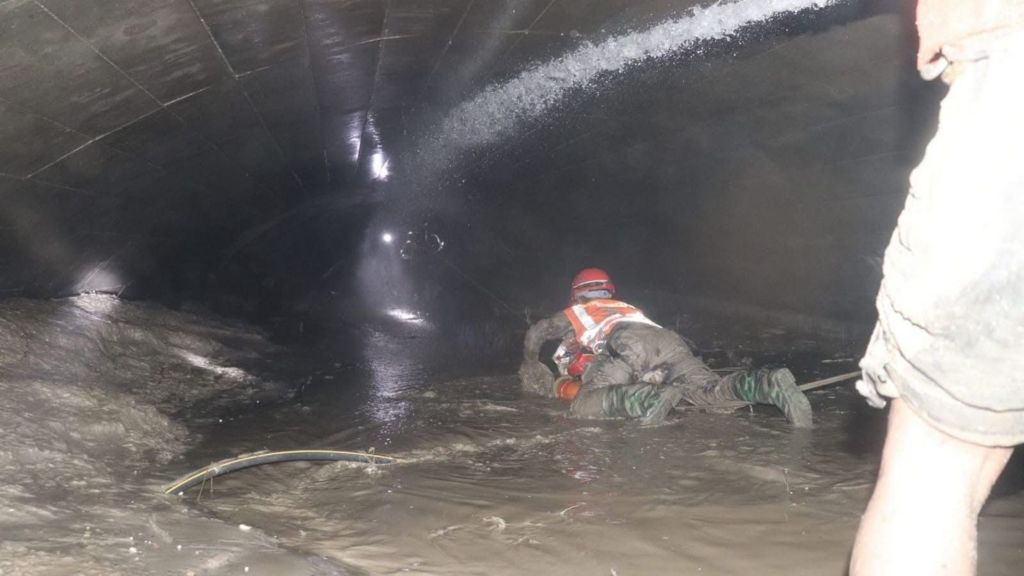
The Nepali army has been working to rescue survivors who had been trapped inside a tunnel at a hydropower project in Rasuwa.
Footage shared by the country’s prime minister office shows soldiers carrying survivors and crawling across thick slates of mud to reach others.
Watch the video below:
James Kelly
Your Voice
 Vikram Kolagatla
Vikram Kolagatla is trying to find out whether his wife, Geetha Reddy, survived the flash flooding.
Vikram, from London, says Geetha, 43, went to the region for a pilgrimage on Saturday and was due back on 4 September.
He hasn’t heard anything from her since the flooding occurred and he isn’t getting “much information” from the British consulate, who he says have told him they are “depending on Nepal to update them”.
Vikram, 50, and the couple’s two daughters, aged 12 and 14, are anxiously waiting to hear any news.
“We’re not sure what to do. I have two little girls, and their schools are starting next week. The kids still don’t believe it.
“They think she’s stuck in the flood and that she’ll come back… there’s no mobile network. I’m trying to tell them to be prepared for the worst,” he adds.

 Azadeh Moshiri
Reporting from Trishuli, Nepal
It is now pouring with rain here in Trishuli. Emergency workers had already told us weather conditions were complicating their rescue missions.
The terrain here is mountainous, and the worst-hit areas on the other side of the river are now isolated.
Bridges have been washed away, and helicopters continue to search for survivors.
We just left the river bank of the Trishuli river, after emergency warnings had eased.
The road and buildings were already submerged in mud from Wednesday’s disaster, and emergency workers were still keeping an eye, worried of any further flooding.
Rescuers are on edge, and this rain won’t help.

 PRAMOD POUDEL AND NARESH GOYAL
As search and rescue efforts continue, many families are desperately waiting for news about their loved ones.
Neetu Goyal Tiwari is one of 33 British nationals missing in the wake of the devastating Nepal-Tibet floods.
“Please help us find her,” her brother Naresh Goyal tells the BBC.
Tiwari, 51, had travelled to Nepal to take part in the Kailash Mansarovar Yatra pilgrimage, which was “her dream”, Goyal says.
She was expected to return to India on Thursday and meet her brother and parents. But now, the family is desperately searching for answers.
Meanwhile Pramod Poudel, who lives in Uckfield in East Sussex, has told the BBC he has not heard from his family – mum, wife, brother and uncle – since the flood hit on Wednesday.
“It’s a very, very difficult time for me and for my family and my country at this moment, but obviously I have to go and see what’s happening there,” he says, adding he is travelling home to Nepal because “my family needs me”.
Read more on this story: Families fly to Nepal in search for 33 missing British nationals
The head of the International Federation of Red Cross and Red Crescent Societies (IFRC) delegation to Nepal, David Fisher, says concerns remain about the potential impact of new flooding in the country.
“We’re of course very concerned about the secondary flood,” Fisher tells a press briefing this morning as he adds that an estimated 93,000 people may have been affected by Wednesday’s disaster.
The IFRC has launched an emergency appeal for CHF 25m (£23m; $31m) to support the “immediate lifesaving response”, the organisation says in a statement, adding it has mobilised “its entire global network”.
Ishwor Joshi
BBC Nepali, Chitwan
The flash flood has washed away many bodies to faraway districts in the downstream and it appears that the identification of the deceased and the handover could be a huge challenge.
The National Disaster Risk Reduction and Management Authority have said 221 dead bodies have been discovered in Chitwan, nearly 186km (299 miles) south of Kathmandu and 134 bodies in Nawalparasi east – located around 200km (321 miles) south of Kathmandu.
Ganesh Aryal, who is the chief district officer of Chitwan, tells the BBC many bodies are not in a good state and the management has become a challenge.
A mortuary at the local hospital is out of capacity, hence the officials have designated a government building to store those bodies.
In the latest update from Nepal Police, it says 547 people are confirmed to have been killed so far, with a further 1,473 people injured.
This is slightly higher than the number of 538 announced by the Nepal’s National Disaster Risk Reduction and Management Authority (NDRRMA) a short while ago.
The force adds that 4,473 police personnel are responding to the disaster.
As operations continue, the Nepali prime minister’s office says “additional” personnel are now on the ground to speed up the search and recovery of bodies following Wednesday’s floods.
A 1,200-strong team has been deployed “along the riverbanks from Rasuwa to Chitwan” and “to all possible locations along the affected areas”.
As we reported earlier, a large number of the bodies recovered so far has been located in the Chitwan district – where the Trishuli river runs its course.
“Despite the river’s strong currents and challenging geographical conditions, the military teams are continuously advancing their efforts to locate and collect bodies,” the statement adds.
The search and rescue operations to find survivors of the flood is in a “critical stage”, says the Chinese embassy in Nepal.
It says the “landslide-dammed lake” caused by the initial flood is “currently at a high water level and has begun to overflow, posing a risk of further breach”.
“The situation is currently at a critical stage for rescue and emergency response in both Nepal and China,” it writes on X.
“Relevant authorities in both China and Nepal are continuing to monitor the situation and assess and manage the risks,” the embassy adds.